

In the wake of the One Big Beautiful Bill Act (OBBBA), the American tax landscape has become significantly more complex. For small business owners and high-net-worth individuals, the choice between a traditional tax preparer and a strategic tax advisor is no longer a matter of semantics – it is a decision that can impact your bottom line by tens of thousands of dollars.
While both professionals handle tax compliance, their approach to your wealth is fundamentally different.
The Tax Preparer: A Retroactive Compliance Officer
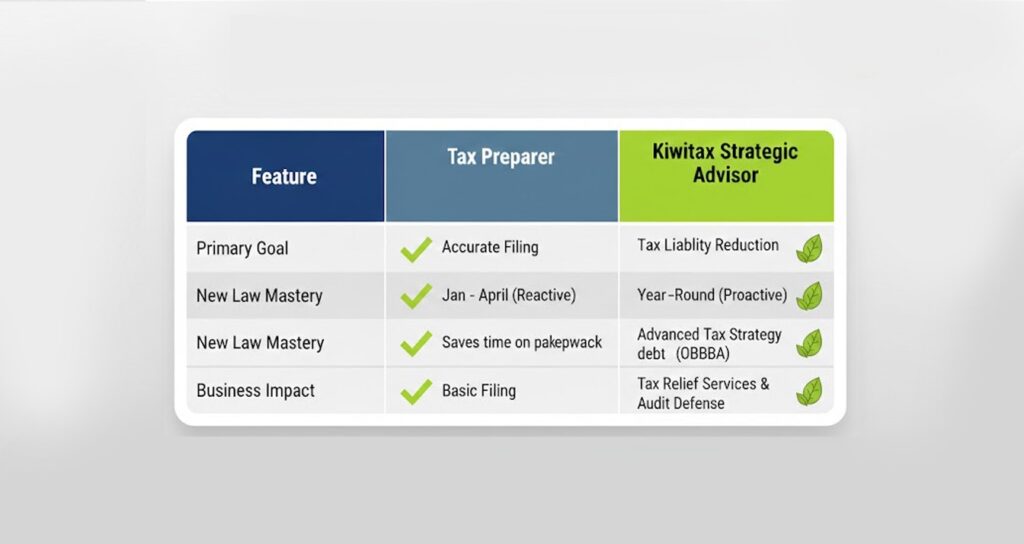
A tax preparer is primarily focused on the “rearview mirror.” Their role is to take the financial data from the previous year and ensure it is reported accurately on forms like the 1040 tax return or Form 1120.
Key Characteristics of Tax Preparation:
- Retroactive: They deal with events that have already occurred.
- Compliance-Focused: Their main goal is to satisfy the IRS and avoid an audit.
- Transactional: You typically interact with them once a year during “tax season.”
If your financial life is straightforward – for example, a single W-2 and a standard deduction – a reliable tax preparer is often all you require.
The Tax Advisor: A Proactive Wealth Strategist
In contrast, a tax advisor looks through the “windshield.” They provide tax consulting throughout the year to shape your financial decisions before they are finalized. At Kiwitax Advisors, we believe a true advisor is an investment that pays for itself through tax optimization.
Key Characteristics of Tax Advisory:
- Proactive: They help you structure deals, equipment purchases, and retirement tax planning before December 31.
- Strategy-Driven: They leverage new 2026 laws, such as the permanent Qualified Business Income (QBI) deduction and updated SALT deduction limits.
Ongoing Relationship: They serve as a year-round partner in your financial planning.
Comparing the Value: Preparer vs. Advisor
Why the OBBBA Makes an Advisor Essential
The 2026 tax year introduced specific incentives that a standard preparer might overlook. For instance, the OBBBA’s new overtime compensation deduction and the permanent reinstatement of 100% bonus depreciation require careful timing and documentation.
A tax advisor will analyze your capital expenditures to determine if you should accelerate a purchase into the current year to lower your bracket. A preparer will simply tell you that you spent the money after the window to change the outcome has closed.
The Kiwitax Standard: Beyond the Form
We understand that you have many “cheap” options for filing. However, as a reliable provider, Kiwitax Advisors focuses on the intersection of accounting and financial advisory. Whether you need corporate tax services for a multi-state LLC or personal tax services for a complex estate, our goal is to ensure you never pay a dollar more than the law requires.
If you’re seeking clear, reliable support with tax preparation, working with a professional can help you navigate the process accurately and with less stress.